
Recruiters do not read duties. They look for proof.
A strong experience section answers three questions quickly: what changed, how you caused it, and why the result mattered. If a bullet only says what you were assigned to do, it leaves the recruiter to guess whether you were effective.
Start by collecting the raw facts behind each role: team size, customer volume, revenue, cost, speed, accuracy, quality, risk, retention, or satisfaction. These details turn a generic task into a specific contribution.
Scope
Name the scale of the work so the reader understands the environment.
Action
Use a precise verb that shows ownership, not participation.
Result
Show the business, team, or customer outcome your work produced.
Use the scope-action-result formula
The simplest pattern is: achieved result by taking action across clear scope. It works because it makes the outcome visible first, while still explaining how you got there.
Result Reduced monthly reporting time by 42%
Action by automating dashboard exports and QA checks
Scope for a 12-person sales operations team.
Before and after examples
Before: Answered customer emails and helped solve problems.
After: Cut average first-response time from 9 hours to 3 hours by rebuilding saved replies and triage labels for a 1,200-ticket monthly support queue.
Before: Created posts for company social channels.
After: Increased demo requests 18% quarter over quarter by launching a LinkedIn content series mapped to buyer objections and sales-call themes.
Before: Worked with vendors and tracked orders.
After: Prevented recurring stockouts across 14 high-volume SKUs by introducing vendor scorecards, reorder alerts, and weekly exception reviews.
Make the bullet easy for ATS systems to classify
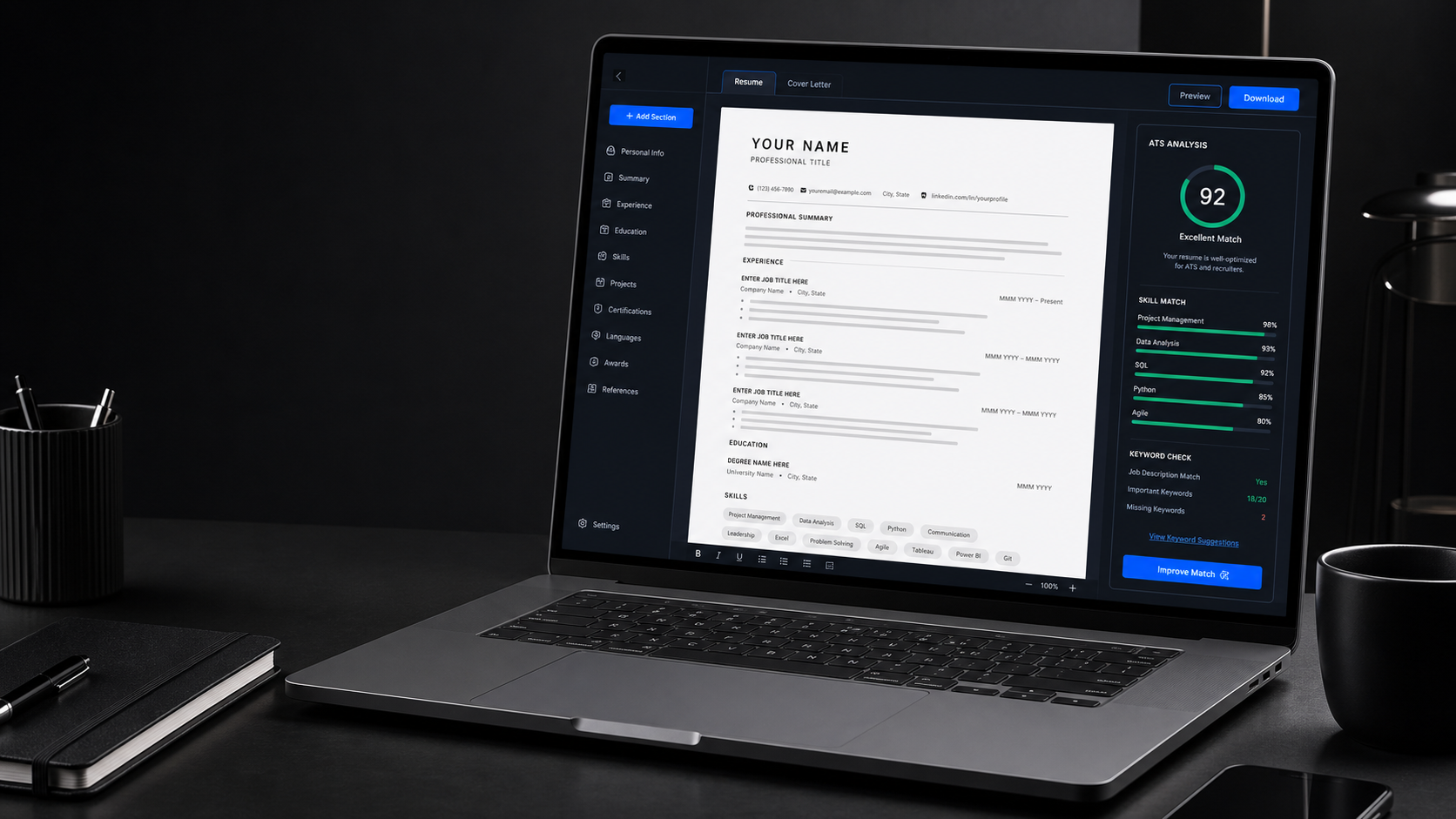
Applicant tracking systems look for role language, skills, tools, and context. Keep keywords natural. If the job description repeats "pipeline reporting," "Salesforce," and "forecast accuracy," use those exact ideas where they honestly match your experience.
- Mirror the job title and skill language when it is accurate.
- Write out acronyms at least once if the industry uses both forms.
- Keep bullets concise enough to scan, usually one or two lines.
- Use standard section labels like Experience, Skills, Education, and Projects.
Final checklist before you publish
Every role has evidence
At least two bullets should include numbers, scope, frequency, or a clear before-and-after result.
Every claim is defensible
Use estimates only when you can explain how you calculated them in an interview.
Every keyword is honest
Do not stuff skills into bullets where you did not use them. Relevance beats volume.
Every line earns space
If a bullet does not add proof, combine it, sharpen it, or remove it.